
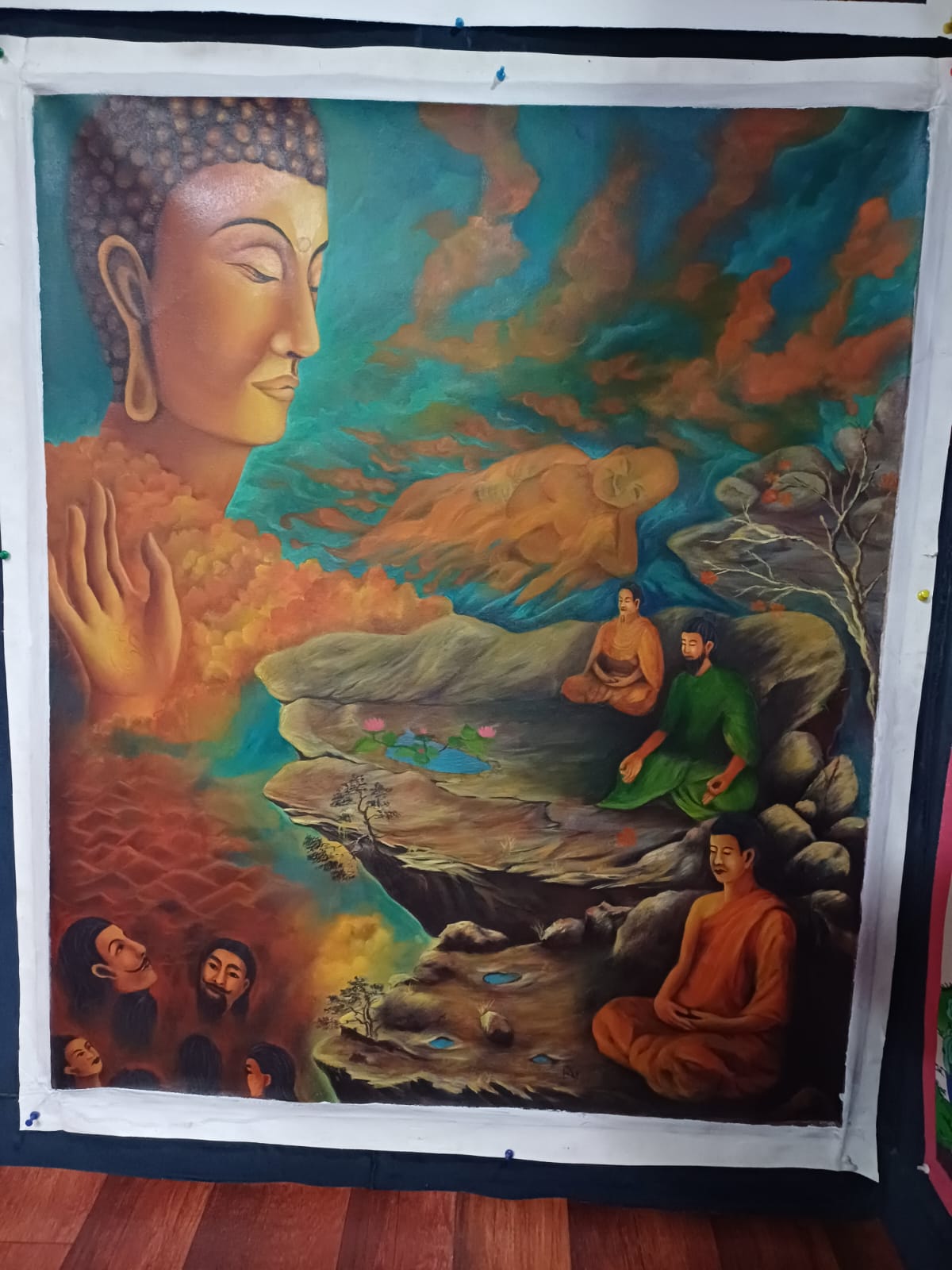
Thangka is a sacred scroll painting which has been woven into Himalayan spiritual life for more than a thousand years. It is a visual scripture, and a meditation support. For people who practice with one regularly it’s something closer to a living presence than a painted image. It was never meant to hang on a wall for decoration.
We find thangkas across Nepal, Tibet, Bhutan and the mountain regions of northern India. They are painted on cotton or silk, mounted on brocade fabric, and built to be rolled up and carried. That was always the whole point. A monk traveling through high mountain passes could carry his entire altar rolled up under his arm.
Today thangkas are recognized around the world not just as objects of devotion but as some of the most technically demanding paintings ever produced.
History of Thangka
The story of thangka painting starts in the 7th century, when Buddhism was just beginning to find its footing in Tibet. King Songtsen Gampo is the figure most associated with opening Tibet to Buddhist teaching during this period. As monks and teachers began making the difficult journey across the Himalayas, they needed a way to bring sacred imagery with them. Temple murals were not going anywhere. So the idea of a portable painted scroll took hold and never let go.
By the 11th and 12th centuries the tradition had matured significantly. Contact with the Indian Pala tradition and the great monastic centers shaped how thangka painters thought about composition and iconography. Around this same time Newari artists from the Kathmandu Valley built a reputation as some of the finest thangka painters in the entire Himalayan world. Their precision and their feel for color became something other traditions actively looked toward.
The 15th and 16th centuries saw distinct schools emerge across Tibet with their own clear identities. The Menri school, established around 1400 CE by Menthangpa Menla Dhondup, set out detailed rules for how deities should be proportioned and depicted. Artists still follow those same rules today. The Khyenri and Karma Gadri schools each carried their own character, one leaning toward fine intricate detail, the other toward something more open and atmospheric.
The 20th century hit the tradition hard. The Cultural Revolution tore through Tibet’s monasteries and effectively shut down sacred art production for a generation. But the knowledge did not disappear. Nepal absorbed it. Kathmandu became the living center of thangka painting during those difficult decades and in many ways it still holds that role. Schools in Boudhanath and Patan are actively training young artists today using the same methods passed down across centuries.
Meaning of Thangka
The word thangka is Tibetan. It roughly means flat painting or recorded message. Some people translate it as something you roll up. That description covers the object well enough but it does not get close to what a thangka actually is.
Nothing inside a thangka is placed by accident. The central figure is almost always a deity, a Buddha or a bodhisattva, representing a quality of awakened mind that the practitioner is working to develop in themselves. The smaller figures arranged around them are not background decoration. Each one points to a stage on the spiritual path or carries a specific dimension of the teaching.
Even the colors are doing work. White speaks to purity. Red to life force. Blue to wisdom. Green to action and energy. Gold to spiritual abundance. Someone trained in reading thangkas moves through the image the way a scholar moves through a text, finding meaning at every turn.
There is something else that people outside the tradition often do not know. A thangka is not considered complete when the paint dries. It only becomes complete after a qualified lama performs a consecration through ritual, prayer and mantra. After that point the image is understood to hold the actual presence of the deity depicted. For a practitioner, sitting in front of a consecrated thangka of Tara is not the same as looking at a picture of Tara. The distinction matters enormously in practice. It is why thangkas are handled carefully and never treated as casual objects.
Importance of Thangka
Thangkas matter for more than one reason at the same time. For Buddhist practitioners they are objects of real devotion, used daily in meditation and visualization practices that some people spend their entire lives developing. In homes across Nepal and Tibet a thangka on the wall is not a design choice. It is a statement about what the household holds sacred.
Beyond personal practice, thangkas function as a kind of living archive. Every painting carries iconographic knowledge, ritual detail and artistic technique that has been transmitted continuously for over a thousand years. That chain of transmission is not something you can easily reconstruct once it breaks.
For the artists and families who have been making thangkas for generations in places like Boudhanath and Bhaktapur, this is also simply a way of life. The work sustains communities. It connects people working today to grandparents and great-grandparents who held the same brushes and ground the same pigments. That kind of continuity is rare anywhere in the world.
Types of Thangka and Mandala:
Buddha thanka
Buddha Thangkas are the most common. Each Buddha represents something specific — Shakyamuni is the historical teacher we all know, Medicine Buddha is called upon for healing, and Amitabha is associated with a peaceful afterlife called the Pure Land.
Bodhisattva Thangkas
Bodhisattva Thangkas feature beings who could reach full enlightenment but chose to stick around and help everyone else first. Green Tara is the quick one you call in a crisis; Avalokiteshvara is pure compassion; Manjushri carries a flaming sword — not for fighting, but for cutting through ignorance.
Mandala Thangkas
Mandala Thangkas are geometric universes painted in extraordinary detail. They’re essentially cosmic maps every circle, square, and deity placed with precise symbolic meaning.
Deity (Yidam) Thangkas
Deity (Yidam) Thangkas are personal practice tools. A meditator focuses on a specific deity like Vajrayogini as a way of transforming their own mind the deity is essentially a mirror of your own awakened potential.
Protector Deity Thangkas
Protector Deity Thangkas show fierce, wrathful figures like Mahakala. They look terrifying on purpose they’re guardians, and their ferocity represents burning away obstacles and negativity.
Lineage Thangkas
Lineage Thangkas are spiritual family portraits great masters like Milarepa or Padmasambhava painted together to show the unbroken chain of teachings passed teacher to student across centuries.
Wheel of Life (Bhavachakra)
Wheel of Life (Bhavachakra) is probably the most storytelling-rich Thangka. A massive demon holds a wheel showing all the realms of existence heavens, hells, animal realms basically a visual map of why we keep suffering and how to get out.
Narrative Thangkas
Narrative Thangkas are Buddhist story panels, like ancient comic books. They illustrate the Buddha’s previous lives or key moments from his life teaching through imagery rather than text.
Types of Mandala
Sand Mandalas
Sand Mandalas are heartbreakingly beautiful monks spend days creating intricate patterns with colored sand, grain by grain. Then they sweep it all away. That is the teaching: impermanence.
Painted Mandalas
Painted Mandalas are the ones you’ll see framed or on canvas rich, symmetrical, often featuring a central deity surrounded by layered symbolic geometry.
Healing Mandalas
Healing Mandalas are less doctrinal and more therapeutic. Circular, calming, and balanced even modern psychology uses them for mindfulness and stress relief.
Teaching Mandalas
Teaching Mandalas are essentially philosophical diagrams. The Five Buddha Mandala, for example, maps five aspects of enlightened mind onto five directions it’s a whole cosmology in one image.
Decorative Mandalas
Decorative Mandalas are what you’ll find in yoga studios and notebook covers today inspired by the sacred originals but adapted for beauty and balance in everyday spaces.
Conclusion
Thangka is not just art. It is a thousand years of devotion, wisdom and human longing for something greater, pressed carefully onto cloth and passed from one pair of hands to the next.